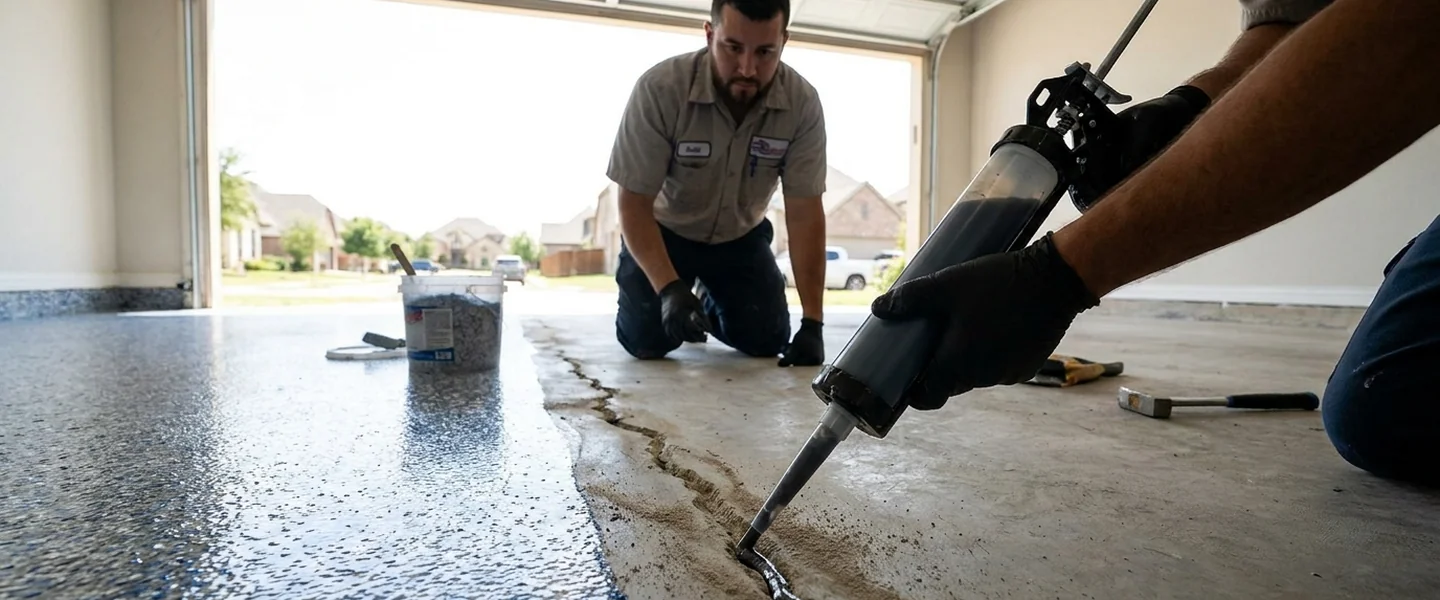
Concrete Floor Repair Fort Worth, TX
Crack injection, spall fill, and slab resurfacing before coating — one mobilization, no return trips.
Call (817) 646-8612Concrete floor repair is the first phase of every epoxy installation we do — but it's also a standalone service for Fort Worth property owners who need a slab repaired before flooring, tile, or any other finish goes down. Fort Worth's expansive Blackland Prairie clay produces more surface cracking, edge chipping, and differential settlement on concrete flatwork than most North Texas homeowners expect. The good news: surface cracks, spalls, and minor settlement are repairable in a single mobilization — no return trips, no extended cure windows before the next trade arrives.
We use polyurea filler for surface cracks (faster cure, more flexible than standard epoxy patch), semi-rigid epoxy mortar for spalls and divots, and a skim-coat resurfacer for widespread surface degradation. Call (817) 646-8612 for a free inspection and written estimate.
What Concrete Floor Repair Means in North Texas
Fort Worth sits on the Blackland Prairie — one of the most active-soil zones in the continental United States. The vertisol clay swells 20–30% when saturated and contracts to a hard, cracked surface during the August drought. This annual expansion-contraction cycle stresses concrete slabs at their weakest points: cold joints, door thresholds, slab edges, and any area where the underlying clay has differential moisture content. The result is a pattern of surface cracks that is essentially universal in Fort Worth concrete flatwork older than five years.
Most of these cracks are cosmetic and structural-movement cracks — they require flexible filler that can accommodate continued micro-movement rather than rigid patch materials that will crack again. We use polyurea filler for this reason: it cures flexible, bonds tightly to concrete, and grinds flush with the surrounding surface. The result is a repaired crack that doesn't re-open or telegraph through the coating system above it.
Project Details
| Typical Timeline | 1 day for repair-only; repair integrated into Day 1 of a coating project |
|---|---|
| Crack Filler | Polyurea (flexible, fast-cure, grindable) |
| Spall / Divot Fill | Semi-rigid 100% solids epoxy mortar |
| Surface Resurfacer | Polymer-modified cementitious skim coat for widespread surface degradation |
| Structural Cracks | Noted and referred to foundation specialist — not covered by floor repair warranty |
| Pricing | Quoted per job after free on-site inspection — every quote is itemized in writing |
Our Repair Process
We categorize every crack and surface defect: hairline surface cracks, medium working cracks, spalls, divots, and any vertical-displacement cracks that indicate structural movement. The written estimate separates cosmetic repair from structural referrals.
Hairline cracks are chased with a crack-chasing blade to open them to a consistent width for filler penetration. All crack channels vacuumed clean of dust and debris.
Two-component polyurea filler injected into crack channels. Fast cure (5–15 minutes) allows grinding within 30 minutes of application. Cured flexible — accommodates continued micro-movement without re-cracking.
Spalled areas and impact divots filled with semi-rigid epoxy mortar. Feathered to match surrounding slab elevation. Flush-ground after cure.
All filled areas diamond-ground flush with the surrounding slab. If the repair is a standalone service (not preceding a coating), the ground surface is left open-profile — ready for the next trade.
Final walkthrough. Any structural cracks noted in writing with recommended next steps. If repair precedes coating, we proceed directly to the base coat application.
Materials We Use
| Crack Filler | Sika SikaFlex-2c polyurea (shore A 35 after cure — flexible, grindable) |
|---|---|
| Spall Fill | Rust-Oleum Concrete Patch & Repair semi-rigid epoxy mortar |
| Resurfacer | Ardex Feather Finish polymer-modified cement skim coat |
| Grinding Equipment | Husqvarna HTC 810 with crack-chasing blade and diamond cup wheels |
Common Scenarios We Repair in Fort Worth
Seasonal Hairline Cracks
The most common repair in Tarrant County — hairline surface cracks from clay-subgrade movement. Filled with flexible polyurea and ground flush. These are cosmetic repairs, not structural concerns.
Garage Apron Spalling
The transition between the driveway and garage floor takes the most abuse. Spalled edges from freeze-thaw cycles and road salt tracked in on vehicles are repaired with epoxy mortar before coating.
Impact Divots from Dropped Tools
Auto shop floors and working garages accumulate impact damage over time. We fill all divots as part of the prep phase so the coating system has a flat substrate to adhere to.
Previous Coating Adhesion Failures
When a previous epoxy or paint system has pulled up chunks of the concrete surface during delamination, the resulting surface is uneven and porous. We fill delamination craters with epoxy mortar before re-coating.
What We Don't Repair (And Why)
We clearly distinguish between cosmetic concrete repair and structural foundation repair. Cracks with vertical displacement (one side of the crack is higher than the other), cracks that are actively growing (new crack propagation visible), and slabs with significant differential settlement (visible slope change) are structural issues that require a licensed foundation repair contractor, not a floor coating crew. We document these in writing during the inspection and recommend appropriate specialists. Applying an epoxy coating over an unaddressed structural issue voids the warranty and is money the homeowner shouldn't spend until the underlying problem is fixed.
Frequently Asked Questions
Can you repair cracks before applying epoxy?
Yes — crack fill is part of our standard prep phase on every coating job. We fill and grind all hairline and medium surface cracks before the base coat goes on. Structural cracks are documented and referred before we proceed with coating.
Will the crack come back through the epoxy coating?
Surface and hairline cracks filled with flexible polyurea filler typically do not telegraph through the coating. The filler accommodates the same micro-movement that opened the crack in the first place. Structural cracks with ongoing movement are a different story — that's why we separate the two in our estimates.
How much does concrete floor repair cost in Fort Worth?
Call (817) 646-8612 for a free written estimate. Repair work is quoted as a line item in the overall coating estimate — you see exactly what the repair component costs versus the coating component.
Do you repair cracks in driveways?
We focus on interior concrete flatwork — garages, basements, commercial floors. Driveway crack repair as a standalone service is outside our scope, though we do repair garage apron spalling as part of a garage floor coating project.
How long does the crack filler take to cure before you can grind it?
Polyurea filler is grindable within 15–30 minutes of application at 70°F ambient. In Fort Worth summer heat, even faster. This is why polyurea is the standard for floor prep — it keeps the project moving without multi-hour cure waits.
How We Quote Concrete Repair Projects
Concrete floor repair is almost always quoted as a component of a larger coating project — the repair line items are broken out separately so you see exactly what prep work costs versus coating costs. For standalone repair projects (repair only, no coating), we provide the same on-site inspection and written estimate process. We visit, assess every crack and surface defect, categorize them as cosmetic repair versus structural referral, and deliver a line-item estimate within 24 hours.
We do not quote concrete repair over the phone. The extent of crack fill required — the factor that varies most between Fort Worth garages — cannot be reliably estimated without walking the slab. A Keller slab from 2005 with two hairline cracks requires a fundamentally different scope than a 1972 Hurst slab with a full crack network and oil contamination. Those differences are real cost differences that a phone quote will either ignore or pad against.
After the Concrete Repair
For repair preceding coating: The repaired slab goes directly into the base coat phase on Day 2. No special treatment of the repaired areas is required — the polyurea filler and epoxy mortar are fully compatible with the epoxy base coat system.
For standalone repair (no coating): The ground-flush filled cracks are open-profile concrete — ready for whatever finish follows (tile, flooring adhesive, or a coating at a future date). The repaired areas will be visible as slightly lighter or darker than the surrounding concrete — this is cosmetic and expected. If appearance of the bare concrete matters, a skim-coat resurfacer can be applied over the entire slab to produce a uniform color.
Long-term expectations for crack fill: Polyurea-filled surface cracks in Fort Worth's clay-movement environment may re-open hairline-thin over one or two seasonal cycles, particularly in the first year. This is the nature of flexible filler in an active-movement substrate — the filler accommodates the movement rather than resisting it and re-cracking the surrounding concrete. In a coated application, this micro-movement is invisible under the coating system. In a bare concrete repair, you may see a faint hairline trace at fill locations after a full seasonal cycle — this is expected behavior, not a product failure.
Related Services
Free Concrete Floor Repair Inspection
We assess, document, and quote every crack and spall in one visit — no obligation.
Call (817) 646-8612What You Get in Our Quote vs. the Lowball Bid
We don't compete on the lowest sticker price — we compete on the quote that gets the job actually done. Here is what is included in every quote we write, and the cut-corners that show up in cheaper bids.
Included in our written quote
- Concrete moisture + porosity testing
- Crack and pitting repair before coating
- Full diamond-grind surface prep
- Written quote with flake/coat specs
- Cure-time schedule you can plan around
- 5-year warranty against delamination
Cut corners in the lowball bid
- Coating over uncured or wet slab
- Roller-only prep (no diamond grind)
- Lowball quotes without crack repair
- Subbed-out installation
- No moisture testing before coat
- Warranties full of fine print